When was the jazz quartet The Dave Brubeck Quartet founded?
Last Updated:
The Dave Brubeck Quartet was founded in 1951 by American pianist and composer Dave Brubeck, a major figure in 20th-century jazz. This iconic group had a profound impact on music history by pushing the boundaries of traditional jazz and introducing new rhythmic structures, while making the genre more accessible to the general public.
Born in California in 1920, Dave Brubeck developed a passion for music at an early age. He studied at the College of the Pacific, then at Mills College with the famous composer Darius Milhaud, who encouraged him to combine jazz and classical music techniques. It was this fusion of styles, both scholarly and instinctive, that would become the pianist’s trademark.
Before founding his famous quartet, Brubeck formed his first group in 1946, the Dave Brubeck Octet, composed of musician friends he had met during his studies. Although experimental and promising, this project remained relatively unknown. It was with the creation of the Dave Brubeck Quartet in 1951 that his career really took off.
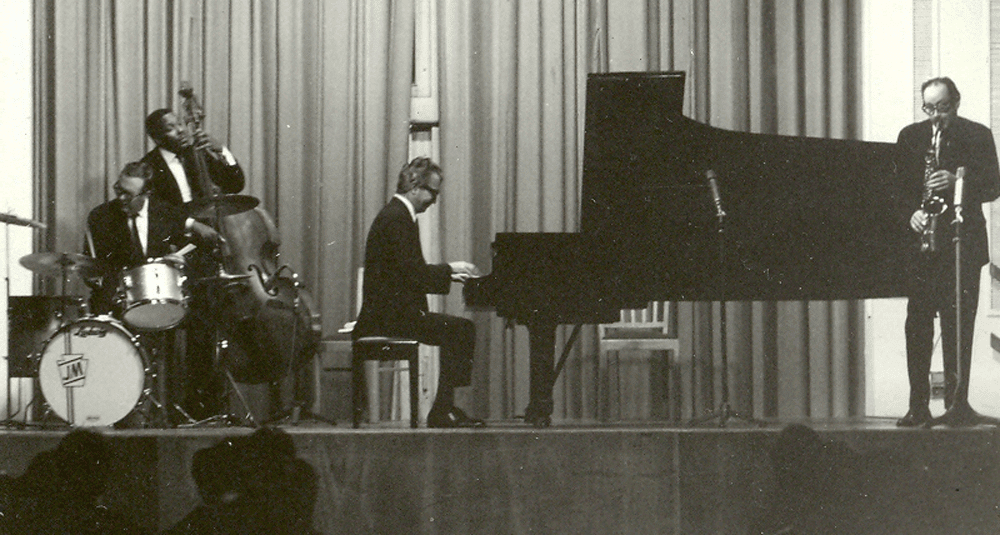
In 1951, Brubeck formed his quartet with several talented musicians. One of them, alto saxophonist Paul Desmond, would become his most loyal musical partner and the soul of the group. The quartet’s classic lineup included:
- Dave Brubeck on piano;
- Paul Desmond on alto saxophone;
- Eugene Wright on double bass (who joined the group later in 1958);
- Joe Morello on drums (who joined the group in 1956).
This lineup would become the most famous quartet, leaving an indelible mark on modern jazz.
From its inception, the Dave Brubeck Quartet distinguished itself with its blend of complex harmonies and innovative rhythms. The group’s compositions explore unusual time signatures, breaking with the classic 4/4 structure that dominated swing jazz.
The Dave Brubeck Quartet combines sophistication and clarity. Unlike many jazz musicians of his time, Brubeck sought to democratize jazz, making it understandable and appealing to a wide audience. His style blends influences from European classical music, blues, and bebop, while maintaining a strong melodic identity.
The group quickly rose to fame thanks to its tours of American universities, an unprecedented initiative at the time. This approach attracted a new generation of listeners, curious to discover a more intellectual but still accessible form of jazz.
In 1959, the quartet made a name for itself with the album Time Out, a revolutionary record that explored asymmetrical rhythms. The track “Take Five,” composed by Paul Desmond, became a worldwide hit and one of the most famous jazz pieces of all time. Its unusual 5/4 time signature, catchy swing, and saxophone solo make it a unique piece.
The album Time Out was followed by several other innovative projects, including Time Further Out (1961) and Time Changes (1963), confirming the quartet’s reputation as a laboratory for rhythmic and harmonic jazz.
The Dave Brubeck Quartet first split up in 1967, after more than fifteen years together, but Brubeck continued to play in various formations, sometimes reforming the group for special concerts.
The Dave Brubeck Quartet left its mark on jazz not only through its compositions, but also through its spirit of innovation and respect for its audience. Brubeck, a staunch humanist, often used music as a bridge between cultures, refusing to perform in venues that practiced racial segregation.
His influence extends far beyond jazz: musicians from progressive rock, classical, and pop have recognized the impact of his rhythmic innovations. In 1996, Brubeck received the National Medal of Arts, and his work continues to be studied in conservatories around the world.
The Dave Brubeck Quartet was founded in 1951, marking the beginning of a musical adventure that revolutionized jazz. Under Dave Brubeck’s leadership, the quartet combined creativity, rigor, and emotion to create a unique sound that was both intellectual and deeply human. With masterpieces such as Take Five, the Dave Brubeck Quartet remains one of the most enduring symbols of the golden age of modern jazz.
music
When was the jazz quartet The Dave Brubeck Quartet founded?
Answer
The Dave Brubeck Quartet was founded in 1951 by American pianist Dave Brubeck, marking an important milestone in the history of modern jazz.